Is gamification just hype or has it become a
Marketing Innovation or Hype?
Marketing for many seems to be a dark art particularly when it comes down to understanding branding.
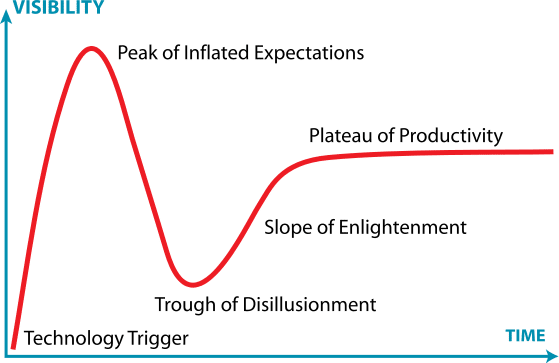
Like many other forms of business, marketing can suffer from the rise and fall of popular trends and the hype that often ensues; common sense seems to get left behind.
However, as understanding progresses we see theory move to practice, strategy move to implementation and measures used as feedback to learn and refine programs and campaigns.
There is a multitude of ideas shaping marketing, location-based services, mobile payments, crowdsourcing…, but I have chosen three that represent interesting ways to realise the benefits of digital and social marketing.
They help to shape a more intuitive set of interactions with customers that can provide relevance, entertainment and context.
Here are the three trends and some information and further resources:
Cross-platform storytelling (transmedia)
A narrative approach using parts of a story across different platforms.
Narratives have been shown to lower the barriers to influence a customer through a process called transportation.
Basically, a customer is transported into a story, and as a result, their normal logical critical awareness lowers.
A second factor that comes from story-telling is the sense of empathy and involvement. In other words, you are demonstrating to customers you understand their lives and their journeys.
Gamification (gaming marketing interactions)
Gamification is at a simple level employing gaming techniques to non-game environments to drive adoption, engagement, loyalty, sharing, even sales e.g. use game mechanics – badges, points, leader boards, levels, challenges, achievements…
Customer Decision Journey (CDJ)
Consumers are increasingly demanding and digital channels are ever more important.
In effect, consumers are taking control of what McKinsey terms the “consumer decision journey” – the moments from awareness to purchase to service; but the emphasis is on the influence and experience from social networks to sales channels to paid media.
In reviewing these trends we need to evade the hype surrounding them and focus on their value; determine the potential benefits and apply them to determine their effectiveness .
Of course, the size of your budget affects the level to which you can scale them and harness their full potential; the reasearch and insights, the creativity and technology underpinning any campaign strategy.
However, even smaller businesses can apply these principles in a more simplistic form as a framework for creative new ways to market themselves.
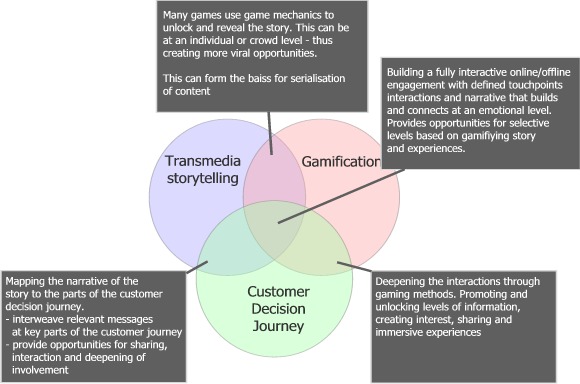
These trends are providing new and exciting ways to engage your customers and create some relevant interactions:
Story Telling across platforms
Why is storytelling so powerful?
Storytelling is at the heart of human behaviour and has run through our cultural heritage as a means to provide entertainment, learning, values…it is the glue that cements us from smaller day to day to the life-changing dramas that change lives.
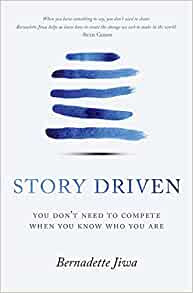
Bernadette Jiwa provides some great points as to how businesses can use storytelling in her book.
We now access information across a multitude of platforms.
By providing access to stories across these customer touchpoints parts of the story can be revealed to build the narrative. However, it is not simply pushing out the same content to different channels.
For instance, a transmedia story may have some of the stories revealed in a video, some through social media e.g. Facebook, and other parts taking place in real life via a live event.
In his book Convergence Culture, Henry Jenkins defines transmedia as storytelling that:
“immerses an audience in a story’s universe through a number of dispersed entry points, providing a comprehensive and coordinated experience of a complex story.”
The point of transmedia storytelling is that multiple entry points provide a rich (and complimentary) opportunity to narrate.
Transmedia requires a mind shift, a change in the creative process to understand the context of each platform.
Though consideration must be given to how the sum of the parts becomes greater than the whole – amplifying the story. In combination with social platforms, this provides an opportunity for higher levels of relevance and interest.
Gamification
Gamification is a buzzword that is surrounded by a lot of media hype and subsequently is often simply labelled as a method to throwing in some badges and incentives to incentivise customers to engage with a brand (a Pavlovian approach to rewarding customers).
Firstly let’s remove some of the hype around gamification here are two excellent articles that drill into the opportunities and issues facing the development and implementation of applied gaming:
Customer Decision Journey
David Edelman does a great job of expressing the customer decision journey in the Harvard Business Review article in 2010 entitled Your Spending Your Money In All the Wrong Places.
The old linear approach as a process for how we decide upon purchase has always seemed convenient but counter-intuitive to the multiple influences that are involved.
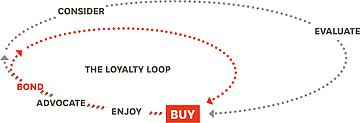
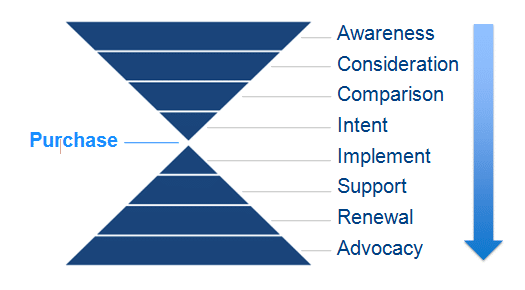
David makes a convincing argument that marketing needs to extend the customer decision journey into the various touchpoints that the customer experiences with the brand and the organisation – from the service dept to the website to the brand’s presence on social media, and resellers sites.
The focus is on building the brand around the customer rather than delivering to the customer based on the organisation.
This fundamental shift in thinking is about realigning older departmental structures and changing the emphasis to organisational adapt to the customer flow. Likewise, a marketer needs to focus on which platforms that influence the customer e.g. advocacy led products require more emphasis on social channels.
Within this mix of touchpoints, social media plays an important part in creating word of mouth.
Google came out with some research called Zero Moment of Truth that very clearly and convincingly lays out the business case for social media and how it impacts the consumer’s buying journey.there’s been a fundamental shift in how consumers gather data and how they’re using that data to make buying decisions for products.